

Start hotshot trucking: define the operation first.
Write down the freight, territory, authority arrangement and working schedule before buying a truck or applying for registrations. Those choices determine which costs and requirements you need to investigate.
Describe a load you intend to carry
Replace “I will haul anything” with a usable operating description: commodity, approximate dimensions and weight range, loading method, pickup and delivery access, appointment pattern and expected service area. For pickup-and-gooseneck work, decide whether the planned cargo can actually be loaded, carried and unloaded with the equipment and help available. Record uncertain facts as questions for a prospective customer or carrier; do not turn them into assumed demand.
Decide whose authority the work would use
Operating under your own authority and leasing equipment to an authorized carrier are different arrangements. Where Part 376 applies, the written lease addresses the parties, duration, possession, control and responsibilities. Read the actual agreement for compensation, deductions, insurance, records and termination. “Leased on” is not a complete description of who pays each bill or keeps each record. Do not assume it removes driver, vehicle or other applicable requirements.
Compare two proposed operations
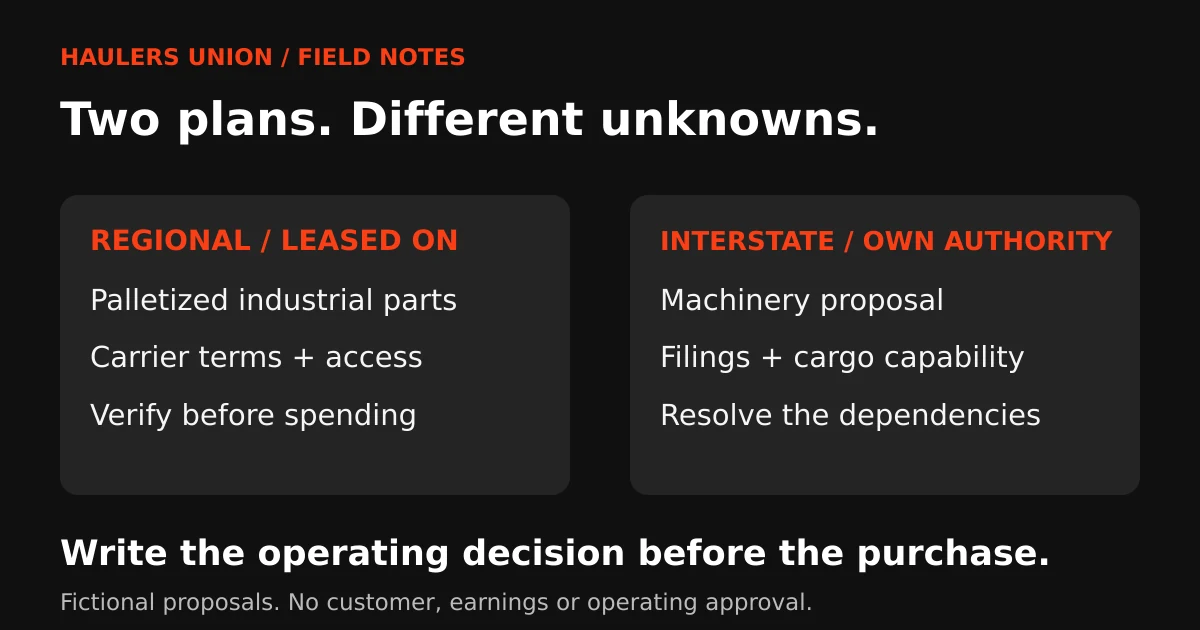
Fictional plan A is regional palletized industrial freight with a stated home-time boundary, under a proposed carrier lease. Its next evidence is the carrier’s written terms, actual loading access and equipment criteria. Fictional plan B is interstate machinery transport under the operator’s own authority. It needs a precise cargo definition, applicable authority/filings, loading and securement capability, insurance terms and a wider trip plan. Neither scenario is a recommendation, a real customer or proof that loads are available.
Keep startup spending separate from operating cash
List one-time setup expenses, recurring fixed costs and trip-dependent costs. Obtain actual dated quotes for the operation you described. Identify owner compensation, tax planning and reserves separately. Then test the cost model against total miles and realistic time tied up. Do not treat an equipment payment as the whole equipment cost, or count loan principal and depreciation twice without an accountant’s method. SBA’s planning resources organize the questions; they do not establish a hotshot income forecast.
Resolve the questions that could change the purchase
Before committing to equipment, obtain the missing cargo/access requirements, the proposed carrier or customer terms, applicable licensing/registration guidance and insurance answers. Write a stop condition beside each unresolved dependency. For example, an unknown loading method can change the trailer requirement; an unconfirmed insurance exclusion can change which freight you can accept. Updating a plan is cheaper than pretending the missing fact is settled.
Your one-page output
Keep the operation description, proposed authority arrangement, required evidence, quote dates, cash assumptions and next decision together. Review it after a material change in cargo, geography, equipment or contract. Use the beginner route to work through dependencies; this page owns the operating-model decision rather than duplicating every registration or equipment rule.
| Decision | Regional leased-on proposal | Own-authority interstate proposal |
|---|---|---|
| Freight | Palletized industrial parts; verify access | Machinery; verify dimensions, mass and loading |
| Authority arrangement | Review the actual carrier lease | Determine authority and filing applicability |
| Commercial evidence | Compensation, deductions and responsibilities | Verified customer/broker and written load terms |
| Equipment decision | Match the carrier and cargo requirements | Match cargo, OEM limits and operational records |
| Before committing | Resolve the lease and loading questions | Resolve registration, insurance and equipment questions |
Original HU editorial text · reviewed 2026-11-04. Sources are linked for verification; no third-party article is republished.
Write a one-page operating plan.
- Name one freight segment and two corridors you understand.
- Compare own-authority and leased-on responsibilities in writing.
- List three assumptions that still need a quote or an official answer.
Sign in to save learning progress.
Progress is private to your account.
Help the editorial team see what needs more context.
What would you add from experience?
A detail from the road can make the starting point more useful.