

Hotshot cost per mile: count the deadhead.
Divide your operating costs by every mile driven, including deadhead. Compare load revenue on the same total-mile basis before deciding whether the work fits your plan.
Build a cost model with your own records
Keep setup spending separate from the operating period. For that period, list fixed costs and variable operating costs. Include fuel, maintenance, tires, tolls, parking, insurance and administration where they apply. Use actual quotes and records. Keep owner pay, taxes and cash reserves visible as separate planning needs; ask your accountant how loan payments and depreciation should enter your model so you do not count equipment twice.
What deadhead means in this calculation
Deadhead is travel without a paying load. Count empty travel to the pickup and any empty repositioning needed after delivery. Here, empty-mile share means empty miles divided by total miles: 150 ÷ 750 = 20%. Someone dividing empty miles by loaded miles would get 25%; that is a different denominator. Label the measure so you can compare trips consistently.
A worked example: 600 loaded miles plus 150 deadhead
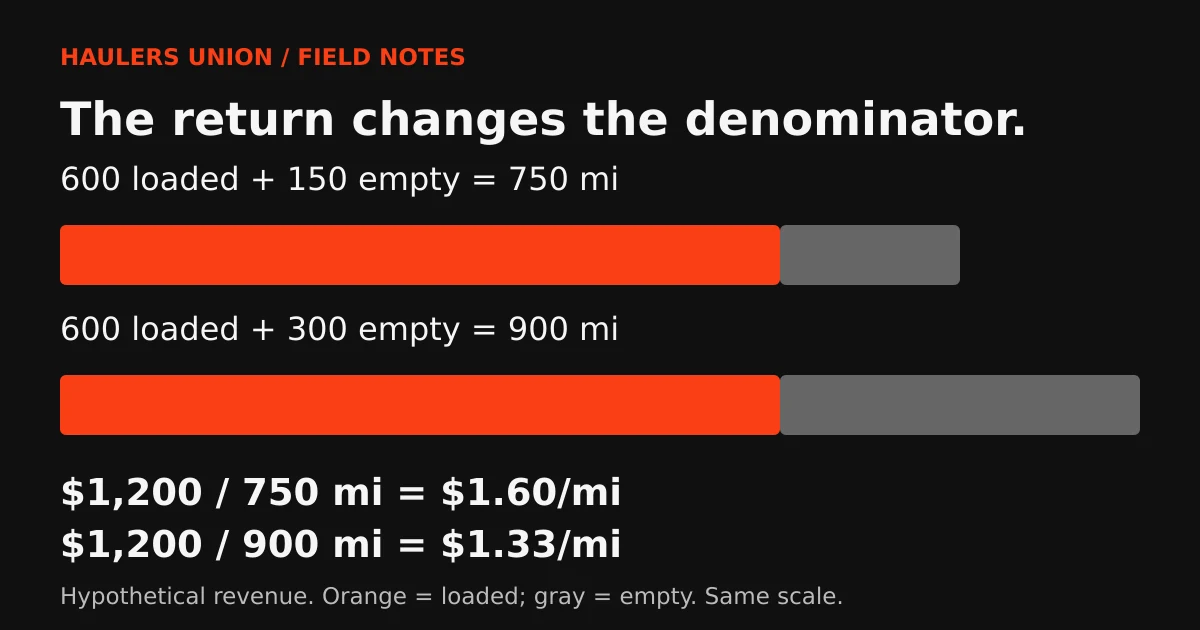
Assume one trip pays $1,200 and requires 600 loaded miles plus 150 deadhead miles, with no extra repositioning. Total distance is 750 miles. The quoted loaded-mile rate is $1,200 ÷ 600 = $2.00 per loaded mile. Revenue across all miles is $1,200 ÷ 750 = $1.60 per total mile. Deadhead is 150 ÷ 750 = 20% of total miles. These are invented planning inputs, not market prices.
Subtract costs on the same basis
For this example only, assume modeled variable costs of $0.75 per total mile and allocated fixed costs of $300 for the trip. Variable costs are 750 × $0.75 = $562.50. Modeled operating costs are $862.50, or $1.15 per total mile. The $337.50 difference from trip revenue is before any owner compensation, taxes or reserves not included in those inputs. It is not take-home pay.
Check the return before you book
If the same trip needs another 150 empty miles to get back to useful work, total distance becomes 900 miles. Holding the example rate and fixed allocation unchanged, variable costs become $675, modeled operating costs $975 and the difference $225. Revenue falls to about $1.33 per total mile. Replace every assumption with your own numbers and check the calculator settings rather than carrying an illustrative rate into a quote.
Booking checklist
Write loaded, deadhead and repositioning miles separately. Record the agreed revenue and payment terms. Check which cost categories your estimate includes. Add loading time, waiting time and realistic stops to the schedule. Run a lower-utilization case against the same fixed costs. Keep the calculation with the written confirmation so you can compare the plan with the actual trip.
Use a floor that matches your cost model
For the first example, $862.50 ÷ 600 loaded miles = about $1.44 per loaded mile just to cover the modeled operating costs. With the empty return, $975 ÷ 600 = about $1.63. Neither floor includes the owner compensation, taxes or reserves excluded from this model. Add those needs explicitly before choosing a quote. A cost floor describes your assumptions; it does not establish what a shipper will pay.
| Measure | Without extra return | With 150-mile return |
|---|---|---|
| Revenue | $1,200 | $1,200 |
| Loaded / empty miles | 600 / 150 | 600 / 300 |
| Total miles | 750 mi | 900 mi |
| Revenue per total mile | $1.60/mi | $1.33/mi (rounded) |
| Variable cost at $0.75/mi | $562.50 | $675.00 |
| Allocated fixed cost | $300.00 | $300.00 |
| Modeled operating cost | $862.50 | $975.00 |
| Difference before excluded pay/tax/reserves | $337.50 | $225.00 |
Original HU editorial text · reviewed 2026-11-04. Sources are linked for verification; no third-party article is republished.
Build a cost-per-mile baseline with your own quotes.
- Collect actual insurance, equipment and operating quotes.
- Enter 600 loaded miles and 150 deadhead miles in your planning calculation; confirm 750 total miles.
- Replace the illustrative $1,200 revenue and $0.75 variable cost with your own inputs, then test the return leg.
Use the Tools load estimate with your own costs. Check whether its inputs include the same expenses and distance as your model.
Sign in to save learning progress.
Progress is private to your account.
Keep your assumptions together
Use the free workbook alongside the load estimate linked above.
Open the free workbookHelp the editorial team see what needs more context.
What would you add from experience?
A detail from the road can make the starting point more useful.