

Plan hotshot parking before the stop gets urgent.
Choose a primary stop and a backup, then confirm access for your pickup-and-trailer combination. A recorded parking location is a starting point, not a space reserved for tonight.
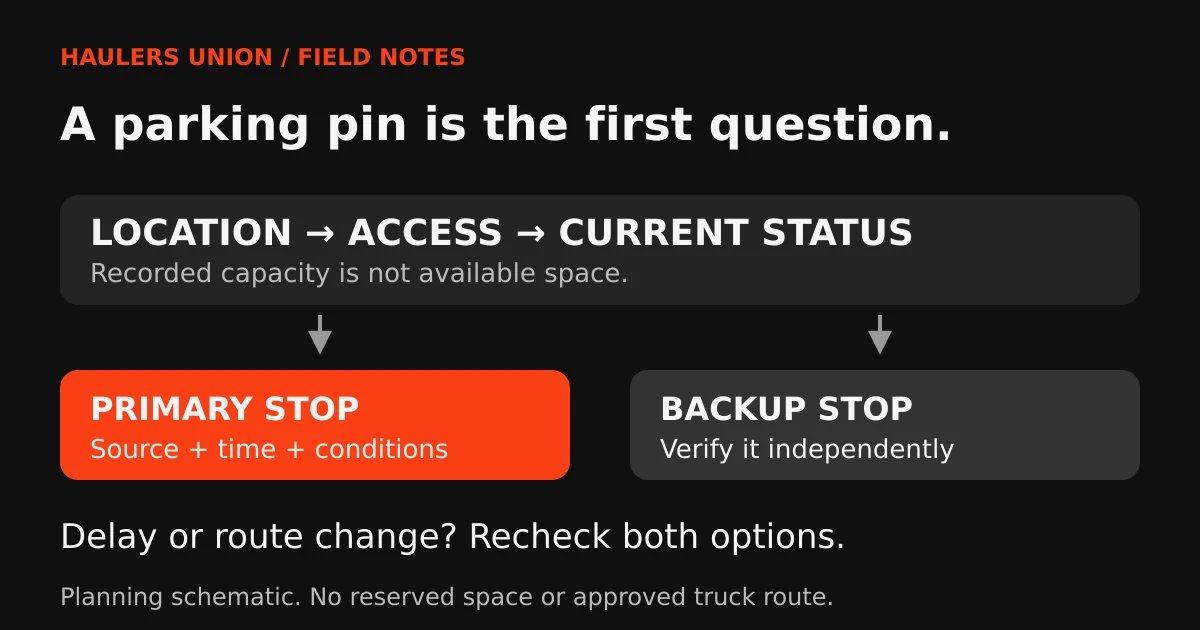
Separate location, compatibility and availability
First locate possible stops along the actual trip. Then check whether the facility accepts your equipment and use: combination length, turning space, entrance restrictions and overnight rules. Finally check the current operating status and parking arrangements directly with the facility. A map pin or recorded capacity answers none of those questions on its own.
Build a primary stop and a backup
Write down each location, the contact or official page used, the time checked and the access conditions confirmed. Choose a backup before the primary stop becomes your only practical option. Include loading, inspections, fuel and foreseeable delays when planning the day; a mapping ETA does not establish that the trip fits the hours available to you.
Use the Union map within its limits
The map includes FHWA/BTS truck-parking inventory compiled in 2019, with the source layer updated in 2024 and imported by HU on October 24, 2026. Import is not a facility inspection. Recorded truck spaces are capacity data, not available spaces. The road route uses an automobile driving profile and does not establish truck-safe routing or equipment compatibility.
Before leaving the shipper
Recheck the next stop after a material delay or route change. Confirm your entrance approach with current state DOT resources and the facility where needed. Keep a usable backup and the source details in your trip record. If access remains uncertain, resolve it before relying on that stop.
| Question | Primary stop | Backup stop |
|---|---|---|
| Official/facility source and time checked | Record source + local time | Record source + local time |
| Combination length and entrance approach | Confirm with facility | Confirm independently |
| Overnight rules / permission / reservation | Record terms | Record terms |
| Current status / arrival window | Recheck before relying on it | Keep a usable alternative |
| After delay or route change | Reassess the next decision point | Confirm it still fits |
Original HU editorial text · reviewed 2026-11-04. Sources are linked for verification; no third-party article is republished.
Prepare the next run
Check regional starting points, then keep a planning checklist close.
Explore regional resourcesHelp the editorial team see what needs more context.
What would you add from experience?
A detail from the road can make the starting point more useful.