

Hotshot fuel cost: diesel price, MPG and every mile.
Estimate diesel spending as total miles ÷ miles per gallon × dollars per gallon. Include the empty miles, use fuel economy from a comparable working setup and test a less favorable case before booking.
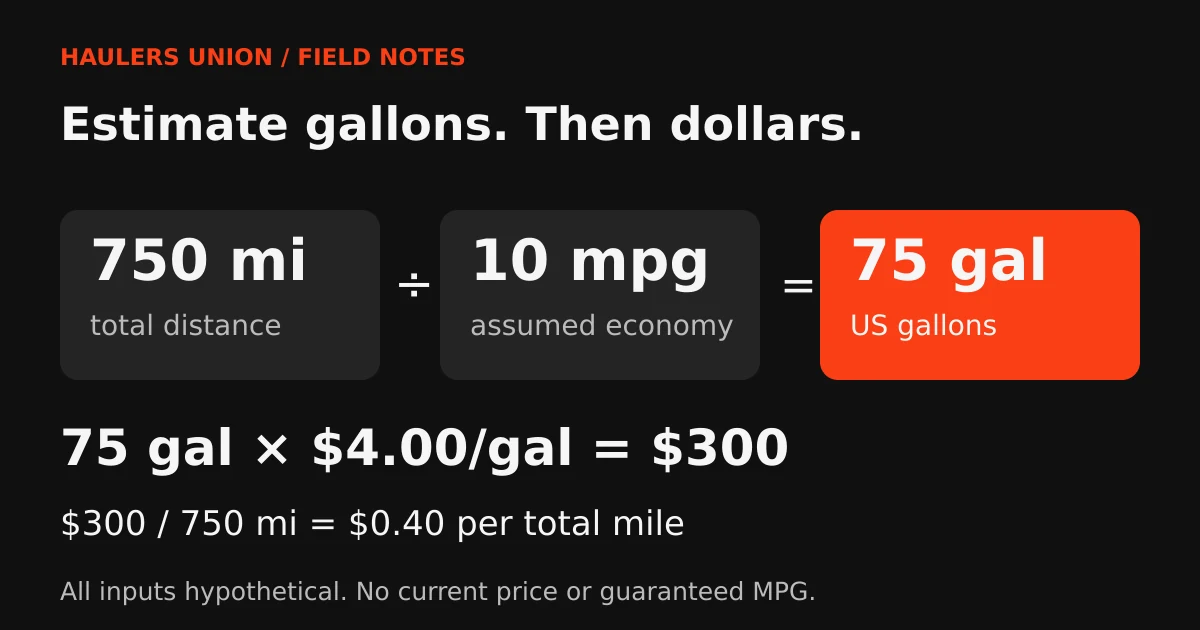
Estimate gallons before dollars
Start with the complete trip distance: empty travel to pickup, loaded travel and the repositioning you expect after delivery. Use miles per US gallon. A dashboard MPG from an empty pickup is not evidence for a loaded pickup-and-gooseneck trip. For a comparable period, divide recorded miles by gallons consumed, using consistent fill-to-fill records. If you lack comparable records, label MPG as an assumption and test a lower value.
Keep the EIA reference separate from a pump quote
EIA publishes weekly national and regional estimates for on-highway diesel. Its survey observes cash self-service pump prices, including taxes, at 8 a.m. local time on Monday, using sampled outlets in the contiguous United States. A regional estimate is a reference, not a quote for the station where you will stop. Record the series, observation date, geography and dollars-per-gallon unit; then record your actual station or card price separately, with any fees or conditions. Open the dated EIA table linked below rather than calling this article a live price feed.
Worked example: 750 miles, 10 mpg, $4 per gallon
Hypothetical inputs only: 600 loaded miles plus 150 empty miles = 750 miles. At an assumed 10 mpg, 750 ÷ 10 = 75 US gallons. At an assumed $4.00 per gallon, 75 × $4.00 = $300.00, or $0.40 per total mile. The $4 input is deliberately illustrative. It is not the EIA price for today, a station offer or a hotshot industry average. Fuel is one expense; this is not a complete trip-profit calculation.
Change one input at a time
At the same 750 miles and 10 mpg, $4.50 per gallon produces $337.50 in fuel spending. Hold price at $4 and reduce economy to 8 mpg: 93.75 gallons cost $375. Add 150 empty return miles while retaining 10 mpg and $4: 900 miles require 90 gallons and $360. If all three changes occur together, 900 ÷ 8 × $4.50 = $506.25. These cases describe arithmetic sensitivity, not a prediction.
Split legs when your records justify different MPG
A more detailed model can estimate loaded and empty gallons separately, then add them. For example only, 600 loaded miles at 8 mpg use 75 gallons; 150 empty miles at 12 mpg use 12.5 gallons. Total fuel is 87.5 gallons, or $350 at $4 per gallon. Do not average 8 and 12 mpg without weighting the fuel used. Additional idling or auxiliary fuel not represented in the MPG record needs its own documented estimate; do not count it twice.
A fuel surcharge is a separate agreement
EIA provides diesel price data but does not calculate, assess or regulate fuel surcharges. Read the actual agreed formula: reference series, base price, mileage basis, assumed efficiency, update timing and rounding. A line called fuel surcharge does not establish that your actual fuel spending is covered. Keep the agreed revenue calculation separate from the trip fuel estimate, then compare the complete load economics.
Before booking, leave a record you can check
Save the total-mile plan, MPG basis, price source/date and the less favorable case with the load estimate. Recheck after a material route, load or price change. After the run, compare the estimate with fuel receipts and actual miles. That comparison is more useful for the next quote than carrying an unexplained generic MPG into every trip.
| Case | Miles / MPG / $ per gal | Estimated diesel |
|---|---|---|
| Base | 750 / 10 / $4.00 | $300.00 |
| Price only | 750 / 10 / $4.50 | $337.50 |
| MPG only | 750 / 8 / $4.00 | $375.00 |
| Return only | 900 / 10 / $4.00 | $360.00 |
| All three | 900 / 8 / $4.50 | $506.25 |
Original HU editorial text · reviewed 2026-11-04. Sources are linked for verification; no third-party article is republished.
Help the editorial team see what needs more context.
What would you add from experience?
A detail from the road can make the starting point more useful.