

Hotshot delivery paperwork: from arrival to invoice.
Record what happened, obtain the agreed delivery evidence and submit a traceable invoice package through verified instructions. Delivery, submission, approval and payment are different events to track.
Check the document requirements before arrival
Review the confirmation and verified customer/broker instructions for the delivery reference, appointment, receiver, proof required and invoicing channel. Resolve missing instructions before they become a dispute at the dock. Avoid posting shipment details, private contacts or documents in public community discussions.
Know what the document is being used to prove
A bill of lading records shipment information and terms; a delivery receipt or signed proof of delivery records an acknowledgment of receipt under its actual wording. They may be combined in one document. For carriers within its scope, 49 CFR 373.101 requires a receipt or bill of lading with specified shipment information. That rule does not establish one universal form, clean signature or payment process for every hotshot contract.
Record exceptions when they occur
Keep the actual arrival/check-in and relevant handling/release events. If the receiver reports a shortage, damage, refusal or other discrepancy, record the specific issue and promptly use the verified agreed channel for instructions. Obtain only permitted photographs and authorized acknowledgments. Do not invent a receiver name, alter an actual document or label a disputed delivery “clean” for convenience.
Build a legible, consistent invoice package
Match the verified load reference, agreed charges, required delivery evidence and any approved accessorial support. Check page completeness, legibility and consistent references before sending. Keep proposed detention calculations distinct from amounts approved for invoicing. Include only the private information needed by the authorized recipient; use verified instructions for any changed payment destination.
Keep submission evidence and track the next state
Save the date, channel, recipient and acknowledgment of submission where available. Apply the actual agreed payment terms and investigate a rejected or incomplete package. An upload, email sent or signed receipt does not itself prove approval or payment. Track the invoice, any dispute, amount approved and cash received separately.
Use a timeline without inventing a real delivery
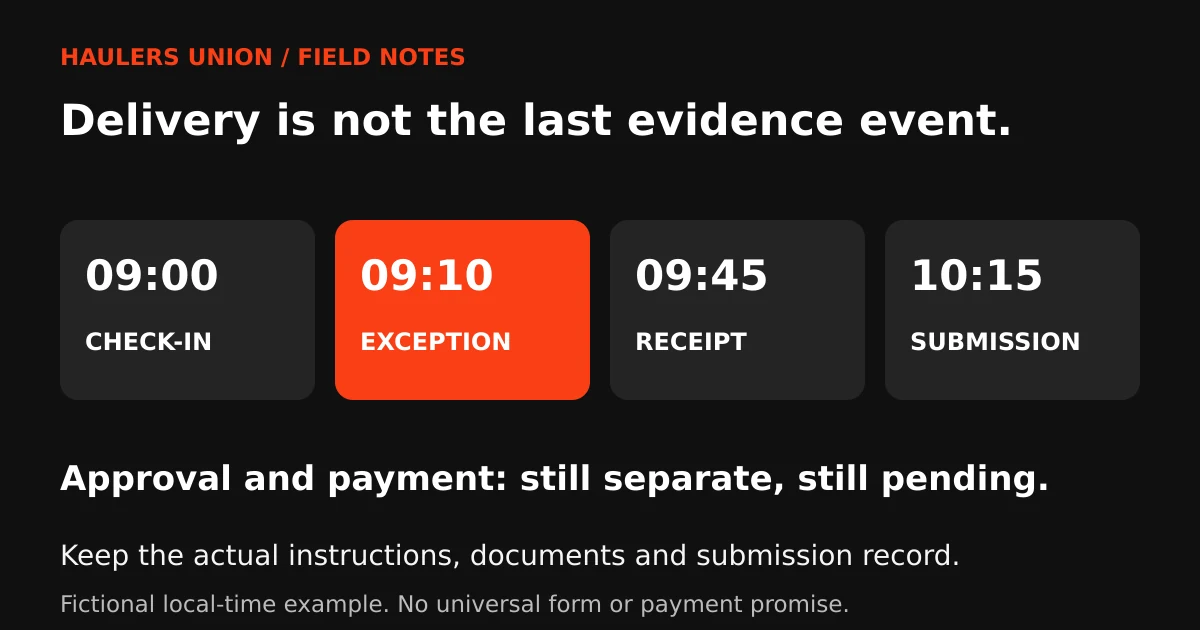
Fictional record: 09:00 check-in, 09:10 discrepancy noted, 09:45 receipt obtained with the actual exception described, 10:15 complete package submitted through verified instructions. Approval and payment remain pending. These times demonstrate distinct evidence events; they are not a standard duration or a recommendation to sign a disputed form.
Retain the supporting record under the applicable rules
Use a retention schedule that covers the relevant transport, contract, tax and other requirements. IRS recordkeeping guidance supports retaining evidence behind business income and expenses; it does not make one period correct for every shipment document. Keep access controlled and backups recoverable, then bring an unresolved legal, claims or tax question to the appropriate qualified professional.
| Event | Example local time | Status / evidence |
|---|---|---|
| Check-in | 09:00 | Actual event record needed |
| Discrepancy | 09:10 | Specific issue and verified notification |
| Receipt | 09:45 | Acknowledgment with actual exception wording |
| Invoice package submitted | 10:15 | Submission evidence retained |
| Approval / payment | Unknown | Track separately; do not infer from submission |
Original HU editorial text · reviewed 2026-11-04. Sources are linked for verification; no third-party article is republished.
Prepare one complete load file from pickup to invoice.
- Prepare a route with a primary and backup stop.
- Review a cargo-specific securement plan with a qualified person.
- Assemble a confirmation-to-invoice sample load file.
Sign in to save learning progress.
Progress is private to your account.
Help the editorial team see what needs more context.
What would you add from experience?
A detail from the road can make the starting point more useful.