

Hotshot detention: record the wait, check the agreement.
Record arrival, check-in, the work and release times. Then calculate any detention request using the written terms for that load. Time spent waiting, the amount you request and the amount approved are three different records.

Before accepting, get the clock and payment terms in writing
Confirm the appointment, the event that starts eligible time, any included time, the rate, billing increments, caps and the notification or approval process. Ask what documentation is required and when it must be submitted. If the answer is missing, record it as unresolved before accepting. Do not treat the illustrative two-hour allowance or $50 rate below as a standard owed on every hotshot load.
Capture the events instead of reconstructing them later
Keep the appointment and load reference, arrival at the location, check-in, who acknowledged it, loading or unloading start and finish, paperwork release and departure. Label the time zone. Early arrival, a closed gate and an appointment-ready check-in may be different events under the agreement. Keep permitted time-stamped evidence and contemporaneous messages; avoid photographing private freight, people or restricted areas without permission.
A timeline you can calculate
Hypothetical agreement: eligible time begins at an acknowledged 08:00 check-in, includes two hours and ends at a 12:30 release. There are no deductions, caps or rounding adjustments in this invented example. Elapsed eligible time is 4 hours 30 minutes. Subtract the 2 included hours: 2 hours 30 minutes remain, or 2.5 hours. At an expressly agreed $50 per hour, the request is 2.5 × $50 = $125. That is a calculated request, not an approved receivable or cash collected.
Check the effect of a different start event
Suppose the same fictional truck arrives at 07:30 but the agreement starts the clock at the 08:00 appointment/check-in. The earlier half hour does not enter this example calculation. If the agreed start were instead 08:30, eligible elapsed time to 12:30 would be four hours and the two-hour excess would produce a $100 request at the same rate. Keep the actual contractual event visible beside the arithmetic.
Notify, submit and track the response
Follow the agreed notification process while the delay is happening. Send a concise event record and the required supporting documents through the verified contact, then retain the submission and response. Track requested, approved, invoiced and collected amounts separately. If records conflict, ask for the specific disputed event or term. A screenshot of a calculator cannot establish what the parties agreed.
Keep detention and layover terms distinct
A same-stop excess-time calculation and a layover arrangement may use different triggers, rates and approval conditions. Confirm which term applies to the interruption in front of you and whether the agreement allows both. Do not rename the same hours to claim them twice. A delay also changes your parking and work plan: recheck the next stop and the hours applicable to your operation.
What the research can and cannot tell you
FMCSA studies detention as an operational and safety issue across commercial motor vehicles. Its research page discusses earlier studies from 2014 and 2018 and the limits of separating normal loading time from additional delay. That background supports keeping better event records. It does not supply a hotshot-specific current detention rate, prove how often your operation will wait or set the payment terms for your load.
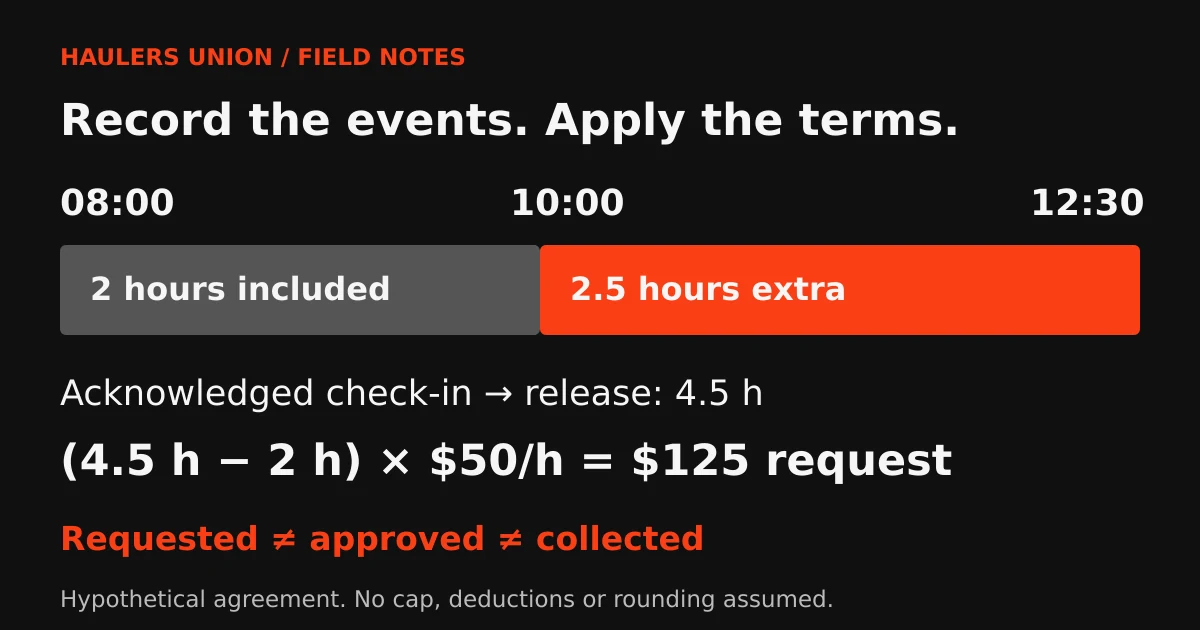
| Record | Example only | What it proves |
|---|---|---|
| Acknowledged check-in | 08:00 | An event; eligibility depends on terms |
| Included interval | 08:00–10:00 | Two hours assumed by this agreement |
| Eligible excess | 10:00–12:30 | 2.5 hours under these assumptions |
| Calculated request | $125.00 | A request, not approval or payment |
Original HU editorial text · reviewed 2026-11-04. Sources are linked for verification; no third-party article is republished.
Help the editorial team see what needs more context.
What would you add from experience?
A detail from the road can make the starting point more useful.