

Your first 90 days in hotshot: compare plan and records.
Review actual miles, fuel, waiting time, operating costs, invoices and cash received each week. Use 30, 60 and 90 days as decision points, not as a promise that the business will become profitable on a schedule.
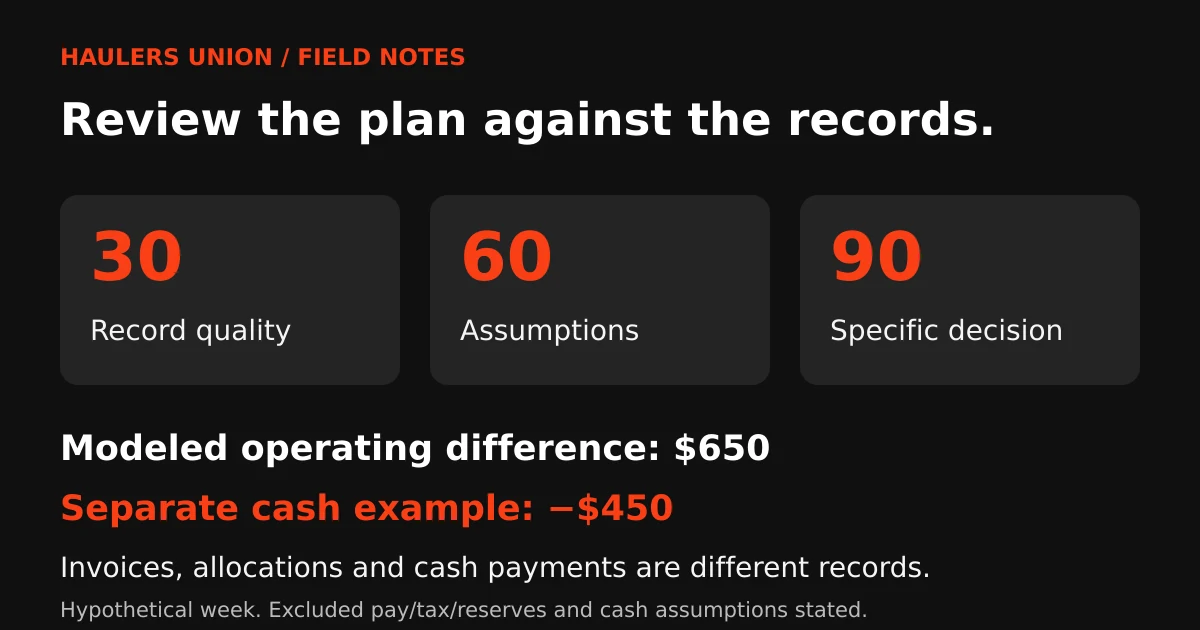
Keep one weekly record backed by the trip files
Record loaded, empty and total miles; fuel gallons and spending; other operating costs; time tied up; agreed/invoiced revenue; approved adjustments; and cash collected. Keep the source documents behind each number. Label estimates, allocations and actual payments. An unpaid invoice and a bank deposit belong in different columns.
At 30 days, check whether the record is usable
Look for missing miles, receipts, delay events and invoice acknowledgments. Confirm that costs use a consistent period and denominator, and that an allocation is not mistaken for cash paid. Fix the record method before drawing conclusions from an attractive gross-revenue total. Revisit the operating plan when the actual cargo, lanes or schedule differ materially from the proposal.
At 60 days, challenge the assumptions
Compare planned and actual empty miles, fuel economy, access delays, invoice corrections and collections. Identify the repeated condition behind an unfavorable difference: for example, extra repositioning or a missing unload requirement. Test a revised assumption in the cost model. Do not infer an industry trend from a few trips or present a single operator’s early results as a hotshot benchmark.
A weekly example with visible exclusions
Hypothetical week: 1,200 loaded miles plus 600 empty miles = 1,800 total miles. Invoiced revenue is $2,600. Assumed fuel expense is $720, other variable operating expense $630 and allocated fixed cost $600. Modeled operating cost is $1,950, leaving $650 before owner compensation, taxes and reserves excluded from these inputs. Those invented values are a recordkeeping example, not expected earnings.
The cash column can tell a different story
Assume only $1,500 of that week’s invoices has been collected; $1,100 remains unpaid. That does not change the example’s invoiced total, but it affects cash planning. If a separate bank record shows $1,950 of cash payments during the week, receipts minus those payments equals negative $450. This is a separate cash-payment assumption: allocated fixed cost is not automatically the same as cash paid. Opening cash, earlier invoices, financing, equipment purchases and taxes would need their own entries.
At 90 days, make a specific decision
Choose what to repeat, clarify, renegotiate or stop based on the evidence. Name the assumption being changed, the record supporting it and the next review point. If the issue is safety, authority, insurance or equipment applicability, resolve it before continuing the affected work; a management review date does not defer a requirement.
Keep the plan current
Maintain a calendar for applicable filings, renewals, inspections and other obligations, alongside the weekly business review. Use actual records with an accountant or other qualified professional for owner pay, tax treatment and consequential financial decisions. SBA/IRS resources explain planning and records; they do not guarantee a result for this operation.
| Measure | Illustrative value | Interpretation |
|---|---|---|
| Loaded / empty / total | 1,200 / 600 / 1,800 mi | Use the same mile basis |
| Invoiced revenue | $2,600 | Not automatically cash received |
| Fuel + other variable + fixed allocation | $720 + $630 + $600 = $1,950 | Modeled operating cost |
| Difference | $650 | Before excluded owner pay, tax and reserves |
| Collected / unpaid from those invoices | $1,500 / $1,100 | Collection status, not an income promise |
| Separate assumed cash payments | $1,950 | Bank-record assumption, not derived from allocation |
| Receipts minus those cash payments | −$450 | Before other cash flows and opening balance |
Original HU editorial text · reviewed 2026-11-04. Sources are linked for verification; no third-party article is republished.
Set a weekly review and a 30/60/90-day decision rhythm.
- Schedule a weekly invoice, cash and cost review.
- Set 30-, 60- and 90-day review dates.
- Bring the actual records and unresolved tax questions to an accountant.
Sign in to save learning progress.
Progress is private to your account.
Help the editorial team see what needs more context.
What would you add from experience?
A detail from the road can make the starting point more useful.