

Hotshot ELD and hours: check applicability and exceptions.
An ELD question starts before the device. Do federal hours-of-service rules apply to this operation? What duty record does this day require? Must that record be created with an ELD?
A non-CDL license, a short trip or a pickup truck does not answer all three.
Hotshot operators do not decide ELD use from CDL status alone. First determine whether federal hours-of-service rules apply. Then determine whether today requires a record of duty status. Finally, check whether that record must use an ELD. A qualifying short-haul operation can use carrier time records; occasional RODS can be manual on no more than eight days in any rolling 30-day period.
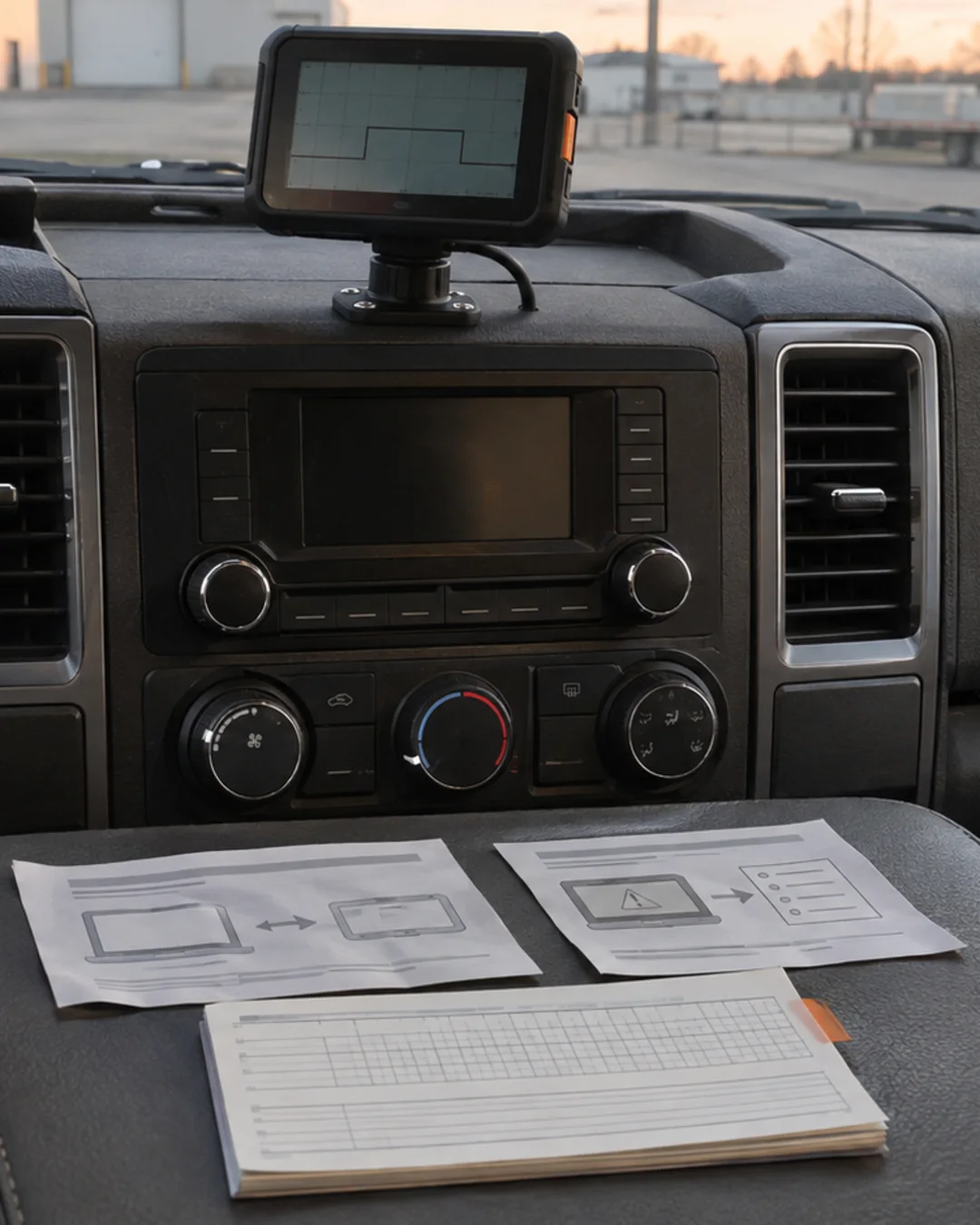
The three decisions
This guide addresses ordinary U.S. interstate property-carrier questions. Specialized operations, passenger service, hazardous materials, agricultural exceptions and state-only operations can require a different analysis.
| Decision | Question | Evidence to keep |
|---|---|---|
| HOS scope | Is the movement and vehicle within the applicable federal rules? | Shipment movement, vehicle ratings/weights, cargo and operation facts |
| Required record | Does today require RODS, or does a fully established exception permit carrier time records? | The exact provision and every condition satisfied that day |
| Recording method | If RODS are required, must they use an ELD or does a specific exception permit manual records? | Rolling-day evidence, exact device status or other exception evidence |
| Change in work | Did the radius, return, duty tour or operation change? | Reassess the branch and keep the correct records. |
Do not start at the third row. A device cannot fix a wrong scope decision, and an ELD exception does not erase any HOS rule that still applies.
Determine the actual movement and vehicle
Begin with the freight movement, not the license class.
A run entirely inside one state can still be interstate commerce when it is one part of a movement that originated or will end outside that state. Record the shipment origin, destination and continuity instead of assuming “I did not cross a state line” settles the question.
For the ordinary federal interstate property-carrier vehicle test, a commercial motor vehicle can include a vehicle or combination with a gross vehicle weight rating, gross combination weight rating, gross vehicle weight or gross combination weight of 10,001 pounds or more, using the applicable rated or actual measure specified by the rule. Passenger and placarded hazardous-material branches are separate.
CDL classification is a different decision. A driver can be operating a CMV for federal safety-rule purposes without meeting the Group A combination threshold. That is why “non-CDL” does not automatically mean “no HOS” or “no ELD.”
Related: Separate CDL classification from CMV duties.
For genuinely intrastate work, check the state’s rules. Do not apply this interstate guide as a substitute for a state determination.
49 CFR 390.5T — CMV and interstate-commerce definitions · 49 CFR 383.5 — CDL definitions
Know the ordinary property-carrier limits
Unless an applicable exception changes the result, the ordinary property-carrier rules include:
- at least 10 consecutive hours off duty before driving;
- no driving after the 14th consecutive hour after coming on duty;
- no more than 11 total hours of driving inside that 14-hour period;
- no driving after more than eight cumulative driving hours without a qualifying consecutive 30-minute interruption in driving status, except for drivers who qualify for the specified short-haul exceptions;
- no driving after 60 on-duty hours in seven consecutive days when the employing carrier does not operate CMVs every day of the week, or 70 hours in eight consecutive days when it does.
The 14-hour period is a driving window, not 14 hours of allowed driving. Waiting at a customer does not automatically become off duty and does not automatically extend the window. Record the actual activity.
An ELD records duty status. It does not create additional legal hours or approve a dispatch decision.
Off-duty, sleeper-berth or on-duty-not-driving time, or a qualifying combination, can satisfy the consecutive 30-minute interruption.
Test the short-haul exception one condition at a time
“Local” is not the regulatory test. Use the exact short-haul branch and verify every condition for the day.
§395.1(e)(1): 150-air-mile radius driver
For an ordinary property-carrying driver using this branch, verify that the driver:
- operates within a 150-air-mile radius of the normal work reporting location;
- returns to that location and is released from work within 14 consecutive hours;
- receives at least 10 consecutive hours off duty separating each 14 hours on duty.
One air mile is one nautical mile. The rule identifies 150 air miles as 172.6 statute miles measured as a radius, not as road distance driven.
The employing motor carrier must maintain accurate time records for six months showing:
- report time each day;
- total on-duty hours each day;
- release time each day;
- the required preceding-seven-day total for a driver used for the first time or intermittently.
When every condition is established, this branch provides relief from the RODS and supporting-document requirements identified in the rule. It does not turn the entire workday into an unrestricted HOS exemption. Keep the required time records and reassess the day if the radius, return or release condition fails.
§395.1(e)(2): property vehicle not requiring a CDL
This is a separate branch. Do not combine its favorable parts with (e)(1).
The driver must operate a property-carrying vehicle for which a CDL is not required, stay within 150 air miles of the normal reporting location and return there after each duty tour. In any period of seven consecutive days, the driver must not drive:
- after the 14th hour after coming on duty on five days; or
- after the 16th hour after coming on duty on the other two days.
The carrier keeps the same categories of accurate time records for six months. The regulation identifies the specific provisions from which this branch provides relief and identifies exceptions with which it cannot be combined. Check the complete branch before relying on it.
When a condition fails
Do not continue marking the day “short haul” by habit.
If the driver exceeds the radius, does not return as required or misses another condition, make a fresh records decision for that day. Determine what RODS are required and whether the rolling ELD exception remains available before dispatching the next run.
The driver-salesperson qualification in (e)(1) has its own terms. Keep the reporting location, radius basis, duty times and the exact branch used in the exception file.
Separate RODS from the ELD method
Where a record of duty status is required, ELD recording is the federal default unless an applicable exception permits another method.
The occasional-use exception permits manual RODS when the driver operates in a manner requiring RODS on no more than eight days within any 30-day period.
This means:
- count only days on which RODS were required;
- use a rolling 30-day period, including the day being evaluated;
- do not reset the count on the first day of a calendar month;
- manual RODS are still required on those days;
- the exception changes the recording method, not the underlying hours limits.
Driveaway-towaway
Check the specific driveaway-towaway provision. It covers a driven vehicle that is itself being delivered, or a qualifying operation transporting a motor home or recreation vehicle trailer. Carrying machinery on a gooseneck does not by itself qualify.
Pre-2000 vehicle rule
Check the model year reflected in the vehicle identification number on the registration. Section 395.8 provides a separate ELD exception for vehicles manufactured before model year 2000.
FMCSA guidance on a replacement engine
FMCSA’s nonbinding guidance separately addresses a documented pre-2000 engine in a later vehicle. The carrier should retain the engine-change documentation at its principal place of business.
49 CFR 395.8 — RODS and ELD exceptions · FMCSA guidance — pre-2000 model-year exception
Work the eighth-day and ninth-day example
Assume an in-scope driver has no other ELD exception. In the rolling period from October 26 through November 24, RODS were required on these dates:
| RODS-required day | Rolling count |
|---|---|
| October 28 | 1 |
| November 2 | 2 |
| November 5 | 3 |
| November 9 | 4 |
| November 11 | 5 |
| November 14 | 6 |
| November 18 | 7 |
| November 21 | 8 |
| November 24 (if RODS required) | 9 — use a registered ELD if no other exception applies |
If November 24 also requires RODS, that day is number nine inside the same rolling 30-day period.
The month changed after the first logged day. The count did not reset.
Determine the required recording method before the ninth RODS-required run. Do not begin the trip assuming paper logs are still available and solve the device question later.
This is a hypothetical count, not a determination for a particular driver. An actual decision depends on the operation, required records and any other fully established exception.
Verify the exact ELD, not only the provider name
When an ELD is required, the carrier must use a device listed on FMCSA’s registered ELD list.
Check:
- exact device name;
- model number;
- ELD identifier;
- software version where listed;
- current registered or revoked status;
- supported data-transfer methods;
- provider support and compatibility with the exact power unit.
The list can change. Recheck the exact device rather than relying on an old screenshot, invoice, provider name or app-store listing. FMCSA’s list records provider self-certification; it is not an agency endorsement of a product.
A portable ELD must be mounted in a fixed position during CMV operation and visible to the driver from the normal seated position.
This guide does not rank devices. A valid device choice still needs the carrier’s operational, compatibility, support and record-access review.
49 CFR 395.22 — carrier ELD responsibilities and onboard packet · FMCSA Registered ELD List
Carry the current three-item onboard packet
For a CMV subject to the ELD packet requirement, the carrier must ensure the driver has onboard:
- an instruction sheet describing the supported data-transfer methods and the steps for producing and transferring HOS records to an authorized safety official;
- an instruction sheet describing ELD malfunction reporting and recordkeeping procedures;
- enough blank RODS graph grids to record at least eight days.
The separate federal requirement to keep the ELD operator’s manual in the CMV ended July 22, 2026. A carrier may still keep the manual voluntarily or because it is operationally useful. Do not list it as a fourth current federal packet item.
The packet must match the actual device. Generic instructions that do not explain the device’s transfer method or malfunction process do not complete the task.
49 CFR 395.22 — carrier ELD responsibilities and onboard packet · Federal Register — rescission of the onboard operator-manual requirement
Use two clocks when an ELD malfunctions
An ELD malfunction does not erase required records.
Driver actions
The driver must:
- note the malfunction and give written notice to the carrier within 24 hours;
- reconstruct the current 24-hour period and the previous seven consecutive days on compliant graph-grid paper logs, unless the records are already possessed or retrievable from the ELD;
- continue preparing manual RODS until the ELD is serviced and restored to compliance;
- provide the required manual records during an inspection.
The exception from reconstructing an already held or retrievable record does not remove the ongoing manual-record duty while the malfunction continues.
Carrier actions
The carrier must act to correct the malfunction within eight days of discovery or the driver’s notification, whichever occurs first.
If more time is needed, the carrier must notify the FMCSA Division Administrator for the state of its principal place of business within five days after the driver’s notice. The signed request must contain the information required by §395.34, including the affected ELD details, malfunction date/location, corrective actions and reason additional time is needed.
Do not merge these deadlines:
| Responsible party | Clock | Required action |
|---|---|---|
| Driver | Within 24 hours | Written malfunction notice to carrier |
| Driver | Immediately for required records | Reconstruct and continue manual RODS as required |
| Carrier | Within 8 days from discovery or notice, whichever is earlier | Correct the malfunction |
| Carrier seeking extension | Within 5 days after driver notice | Submit the required extension request |
Match the record to today’s situation
| Today’s established situation | Record path |
|---|---|
| Every condition of the applicable short-haul branch is satisfied | Carrier keeps the time records required by that branch; driver does not create RODS under the specified relief |
| RODS are required on no more than eight days in the rolling 30-day period and the occasional-use exception applies | Driver creates compliant manual RODS |
| RODS are required on the ninth day in the rolling period and no other ELD exception applies | Use a currently registered ELD |
| Another specific ELD exception is being considered | Verify every condition and keep its supporting evidence; do not combine exceptions casually |
| Required ELD malfunctions | Follow the driver and carrier malfunction procedures; continue the required manual record |
Keep the dated facts, exact rule branch and unresolved questions. “We normally stay local” is not a record.
49 CFR 395.1 — scope and short-haul exceptions · 49 CFR 395.8 — RODS and ELD exceptions · 49 CFR 395.34 — ELD malfunctions
Stop before dispatch when the record decision is unresolved
Pause when:
- interstate or intrastate scope has not been established;
- vehicle rating or actual-weight facts are missing;
- CDL status is being used as the only HOS test;
- a short-haul condition is assumed rather than documented;
- the rolling count is incomplete;
- the ninth RODS-required day is approaching without an established recording method;
- the exact ELD is missing from the current registered list or appears as revoked;
- the onboard packet does not match the installed device;
- a malfunction has not been reported or required records cannot be produced.
An available load does not resolve a compliance question.
Frequently asked questions
Do hotshot drivers need an ELD?
Some do and some do not. Determine whether federal HOS rules apply, whether the day requires RODS and whether an ELD exception applies. Vehicle type or CDL status alone does not answer the question.
Does a non-CDL hotshot operator need an ELD?
Possibly. Non-CDL status does not automatically remove CMV, HOS or duty-record requirements. A separate short-haul branch exists for qualifying property vehicles not requiring a CDL, but every condition must be satisfied and documented.
Is the short-haul limit 150 road miles?
No. The federal short-haul provisions use a 150-air-mile radius from the normal work reporting location. The rule identifies that radius as 172.6 statute miles. It is not the number of miles driven on the road.
What happens on the ninth RODS-required day?
The occasional-use exception permits manual RODS on no more than eight days within any rolling 30-day period. If the current day is number nine and no other ELD exception applies, the required RODS must use a registered ELD.
Can I use any ELD app?
No. When an ELD is required, the carrier must use an exact device currently listed on FMCSA’s registered ELD list. Verify the model, identifier, status, transfer method and compatibility. An app-store listing is not enough.
What must be in the truck with the ELD?
The current federal packet contains the device-specific transfer instruction sheet, the malfunction/reporting instruction sheet and at least eight days of blank RODS graph grids. The separate federal operator-manual requirement ended in July 2026.
What should I do if the ELD fails?
Give written notice to the carrier within 24 hours, reconstruct the current day and previous seven days when required, and continue manual RODS until the device is restored. The carrier has a separate eight-day correction clock and a five-day deadline for an extension request.
Sources & editorial status
49 CFR 390.5T — CMV and interstate-commerce definitions 49 CFR 383.5 — CDL definitions 49 CFR 395.1 — scope and short-haul exceptions 49 CFR 395.3 — property-carrier driving limits 49 CFR 395.8 — RODS and ELD exceptions 49 CFR 395.22 — carrier ELD responsibilities and onboard packet 49 CFR 395.34 — ELD malfunctions FMCSA Registered ELD List FMCSA guidance — pre-2000 model-year exception Federal Register — rescission of the onboard operator-manual requirementOriginal Haulers Union editorial guide. Reviewed November 24, 2026. The eCFR Title 49 pages used for this review displayed an update date of November 20, 2026. This page is an educational decision workflow. It does not calculate available hours, approve a shift, establish a state-law result or replace a carrier’s qualified compliance review.
Help the editorial team see what needs more context.
What would you add from experience?
A detail from the road can make the starting point more useful.