

Non-CDL hotshot: which requirements still apply?
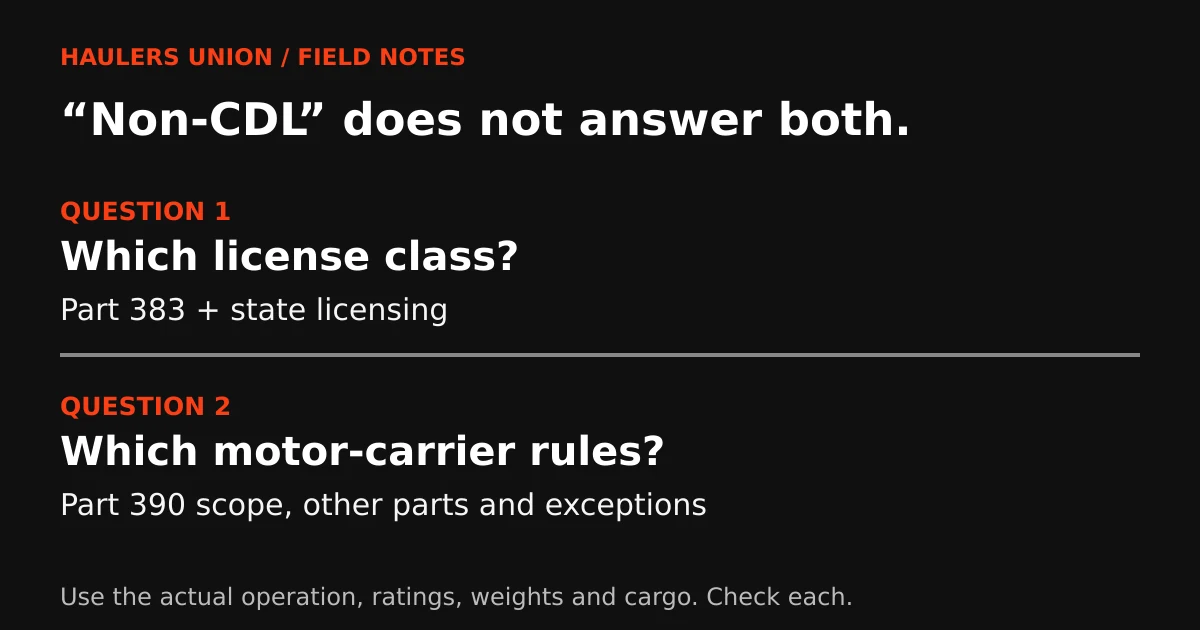
Treat CDL classification and other commercial-vehicle obligations as separate checks. “Non-CDL hotshot” is a description, not permission to operate a particular pickup-and-trailer combination.
Collect the operation and equipment facts
Record the state issuing the license, whether the operation is in commerce, the cargo, the interstate or intrastate context, the truck and trailer ratings, actual operating weights and the source of each value. Keep label photos and scale records private in the equipment file. A trailer’s advertised deck capacity or a seller’s “non-CDL setup” label does not supply all those facts.
Check the combination-vehicle branch accurately
Under the weight-based Group A definition in 49 CFR 383.5, compare the larger of gross combination weight rating and gross combination weight with 26,001 lb. That branch also requires a towed unit whose larger gross vehicle weight rating or gross vehicle weight exceeds 10,000 lb. Both parts matter. The regulation defines GCWR for this purpose; it is not necessarily a single brochure towing figure. Read that definition with your actual labels and weights rather than testing only today’s cargo weight.
Do not turn a failed Group A test into a blanket exemption
Other license classifications, hazardous-material or passenger provisions and applicable exceptions can change the answer. FMCSA’s driver guidance explains the federal classes; your state licensing authority determines the license and restrictions for your situation. This guide does not assess a specific driver’s qualifications, medical certification, endorsements, training or a state exception. Get the determination for the actual operation and keep its basis.
Run the broader CMV check separately
For the weight branch of the interstate-highway property CMV definition in 49 CFR 390.5T, the threshold is 10,001 lb or more using the greatest applicable rating or actual vehicle/combination weight. The section has additional passenger and hazardous-material branches. An operation can therefore be below the weight-based CDL combination threshold while still falling within other federal motor-carrier safety rules. Review applicability and exceptions for driver qualification, hours, records, inspection and maintenance rather than assuming “no CDL” removes them.
Interstate does not mean only crossing a state line yourself
FMCSA’s USDOT guidance includes in-state transportation that forms part of trade originating or terminating outside the state, as well as trips crossing state or national boundaries. State intrastate requirements are a separate check. Describe the actual movement and cargo to the agency or qualified adviser; a map showing one state is not a complete applicability determination.
Keep a dated determination, then recheck changes
Use a separate row for CDL, USDOT/safety rules, authority, insurance, hours/ELD and state obligations. Record the source, facts supplied, answer and unresolved question. Revisit the record when ratings, equipment, cargo, actual weights or operating territory change. Do not load above any applicable rating or limit while testing a licensing threshold.
| Question | Relevant starting point | Evidence to retain |
|---|---|---|
| Which CDL class applies? | Part 383 and state licensing authority | Ratings, actual weights, cargo and written determination |
| Do federal CMV safety rules apply? | Part 390 scope/definitions and exceptions | Operation context and greatest applicable weights |
| USDOT / authority / insurance? | FMCSA registration and Part 387 | Separate applicability and current status records |
| HOS / records / ELD? | Part 395 and applicable exceptions | All conditions and the required records |
| State-specific obligations? | Relevant state agencies | Dated guidance for the actual states/operation |
Original HU editorial text · reviewed 2026-11-04. Sources are linked for verification; no third-party article is republished.
Help the editorial team see what needs more context.
What would you add from experience?
A detail from the road can make the starting point more useful.