

Hotshot insurance: compare coverage, filings and quotes.
Send the same accurate operation profile to each licensed insurance provider, then compare covered work, exclusions, deductibles and required filings. The lowest premium is not enough information to choose a policy.
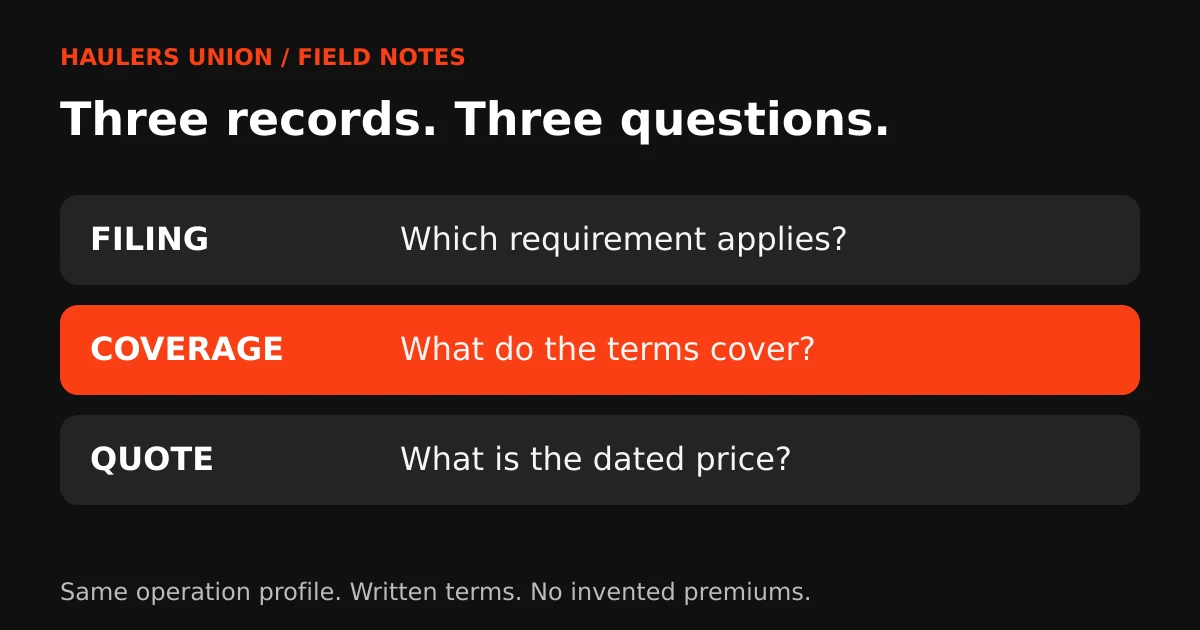
Give each provider the same operation profile
Describe the legal entity, authority arrangement, drivers, pickup and trailer configurations, cargo types and maximum values, service area, storage arrangements and expected work. Ask what additional information the provider needs and keep the dated quote conditions. Changing the cargo or radius between requests makes the premium comparison misleading. No real quotes or operator-specific premium estimates are supplied in this guide.
Separate the federal filing from the policy’s coverage
FMCSA’s filing requirements vary by entity, authority, cargo and vehicle type. Its current chart lists $750,000 in bodily-injury/property-damage financial responsibility for the non-hazardous for-hire property category at GVWR of 10,001 lb or more. That is a scoped filing reference, not a universal hotshot insurance package or a recommended limit for every risk. Part 387 contains the legal scope and exceptions. Confirm the applicable category and forms with the provider and official guidance.
Read the cargo row in context
The same FMCSA chart shows no federal cargo-insurance filing amount for that general non-hazardous property category; household goods and other categories differ. A zero in that filing column does not mean cargo is insured, that a customer will accept no cargo coverage or that losses are affordable. Compare the actual policy terms and the load’s written requirements separately.
Ask about the work that could fall outside coverage
Obtain written answers about the cargo, loading/unloading, unattended equipment, theft conditions, storage, operating area, hired or non-owned equipment and work under a carrier lease where relevant. These are questions to resolve, not assertions that every policy contains the same exclusion. Clarify deductibles, sublimits, covered parties and the effective date before accepting a load whose requirements depend on that answer.
Compare quotes only after aligning the terms
Use one row per coverage or condition and one column per dated quote. Record the insurer/provider, forms or endorsements referenced, limits, deductible, exclusions, filings, payment schedule and total stated premium/fees. If a proposal is incomplete, label the field unanswered rather than treating it as included. Ask a licensed provider to explain consequential differences for your actual operation.
Keep filings and changes current
Verify that required filings reached the official record and remain effective. Tell the provider about a material equipment, driver, cargo, territory or authority-arrangement change before relying on old answers. A certificate or filing can be part of the evidence, but neither replaces the policy terms. Keep claim and shipment information private; this is a comparison workflow, not a coverage determination.
| Compare | Quote A | Quote B |
|---|---|---|
| Same operation and date | Record facts / date | Record facts / date |
| Covered cargo and activities | Written terms / unanswered | Written terms / unanswered |
| Limits, deductibles and sublimits | Policy/endorsement reference | Policy/endorsement reference |
| Exclusions and conditions | Ask provider to explain | Ask provider to explain |
| Required filings and effective date | Confirm applicable status | Confirm applicable status |
| Premium, fees and payment schedule | Actual dated quote only | Actual dated quote only |
Original HU editorial text · reviewed 2026-11-04. Sources are linked for verification; no third-party article is republished.
Help the editorial team see what needs more context.
What would you add from experience?
A detail from the road can make the starting point more useful.