

Hotshot equipment checklist: verify the whole combination.
A hotshot setup is not one number and it is not one shopping list. It is a working combination: pickup, trailer, hitch system, tires, cargo-control equipment and the load you plan to move.
The useful question is not, “What gear does everybody carry?” It is:
What must this exact combination prove, what does this freight require, and what must be checked before today’s run?
A useful hot shot equipment checklist has three layers: evidence for the truck-and-trailer combination, equipment selected for the freight, and a dated pre-trip check. Verify the actual ratings and condition of every load-carrying component. Do not rely on a generic tow rating, universal strap count or copied shopping list.
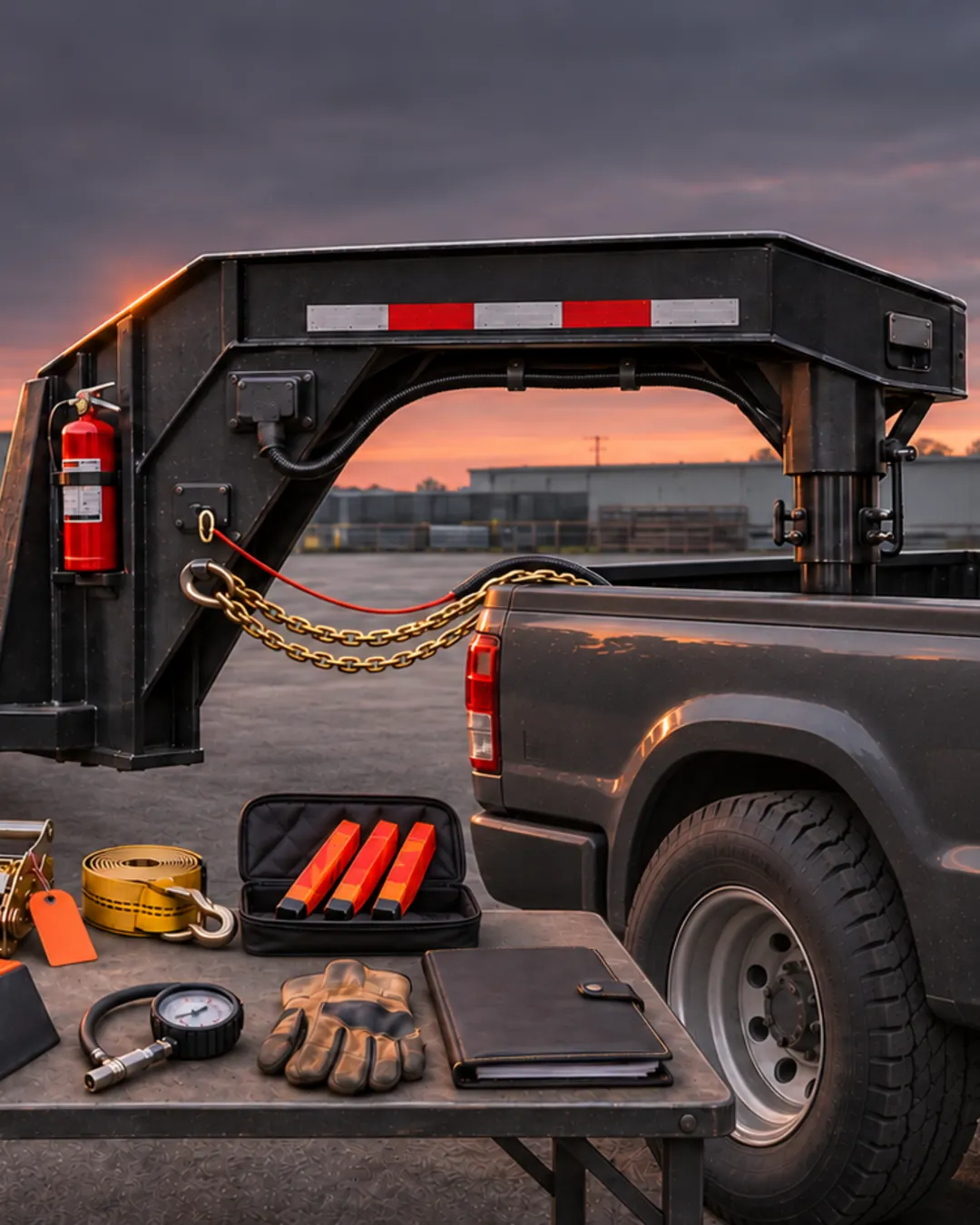
The checklist at a glance
| Layer | What belongs here | What closes the check |
|---|---|---|
| Combination evidence | Truck configuration, trailer label, hitch and coupler, tires, wheels, ratings and working weights | Matching manufacturer documentation, actual labels and measurements |
| Emergency equipment | Equipment required for the covered operation plus any additional state, contract or operator-selected items | Correct type, condition, accessibility and a dated check |
| Cargo-specific equipment | Tiedowns, binders, edge protection, blocking, dunnage, tarps or other equipment selected for the actual freight | Cargo information, applicable securement rules, equipment ratings and a competent securement plan |
| Working supplies | Tools, lighting, PPE and replacement items chosen for the operation | A stated reason, usable condition and replenishment rule |
| Pre-trip condition | Truck, trailer, connections, visibility, cargo and unresolved defects for today’s run | A completed walkaround and resolution of open items |
The first four rows form your equipment record. The pre-trip row changes every time the equipment, cargo or condition changes.
Identify the truck and trailer you are actually using
Start with the exact configuration, not the largest number printed in an advertisement.
For the pickup, record:
- model year, model and drive layout;
- cab, bed and wheelbase;
- engine and axle ratio;
- installed towing package and relevant modifications;
- GVWR and front/rear axle ratings from the vehicle labels;
- the applicable combination or towing information from the matching manufacturer guide.
For the trailer, record the following hotshot trailer equipment and configuration details:
- manufacturer, model and VIN;
- GVWR and axle ratings from the actual certification label;
- deck dimensions and configuration;
- tire and wheel specifications;
- coupler type and rating;
- installed equipment or modifications that affect the working setup.
For the connection, identify the installed hitch, ball, coupler, safety-chain system, electrical connection and breakaway equipment. Keep the matching manufacturer instructions. A component that looks similar is not evidence that its rating or installation matches your combination.
Ratings and working weights answer different questions
Manufacturer ratings describe limits. Scale readings describe one operating condition.
Your working check can include the truck, trailer, occupants, fuel, hitch hardware, tools, spare equipment and cargo. Trailer vertical load uses truck capacity and can change axle loading. Passing a total combination check does not prove that the rear axle, tire, wheel, hitch or trailer is within its own limit.
Use a suitable scale and the manufacturer’s prescribed method. Save the date and loading condition with the readings. If a rating, configuration or measurement cannot be matched, leave it unresolved. Do not replace a missing fact with the highest number found online.
Ford’s 2026 RV & Trailer Towing Guide (pp. 6–7 and the matching configuration selector) is one example of configuration-specific documentation. It is not a rating for every pickup or for an HU example rig. Use the exact documentation for your own vehicle and installed components.
Related: Separate CDL classification from CMV duties. A legal classification does not increase an equipment rating.
Record emergency equipment by requirement and operation
For a covered power unit in ordinary non-hazardous-material operation, 49 CFR §393.95(a) allows either:
- one fire extinguisher rated at least 5 B:C; or
- two fire extinguishers rated at least 4 B:C each.
The extinguisher must meet the applicable marking, charge, mounting and accessibility conditions. Placardable hazardous-material operations have a different minimum. Do not use this ordinary-freight example for a different operation.
Three compliant bidirectional reflective triangles are one federal warning-device option for a covered power unit. The rule contains restrictions and alternatives for specified operations, so record the option your operation actually uses.
The former federal spare-fuse requirement in §393.95 was removed effective April 20, 2026. You may still choose to carry suitable spares. A state rule, contract, manufacturer instruction or operating practice may also create a separate reason. Label that reason accurately; do not call spare fuses a current universal federal requirement.
Emergency-equipment record
For each item on your hotshot equipment list, keep:
- the requirement or operating reason;
- the exact item and rating where applicable;
- mounting or storage location;
- condition and inspection date;
- replacement, recharge or expiration rule;
- unresolved damage, missing marking or access problem.
This makes the checklist maintainable. A box marked “present” is not enough if the item is discharged, damaged, buried or unmatched to the requirement.
Build cargo-control equipment around the freight
A copied gear count cannot tell you whether a load is properly secured.
The right equipment depends on the cargo, its weight and dimensions, its contact with the deck, blocking or immobilization, tiedown routing, anchor points, working load limits and any commodity-specific rule.
Under the general federal working-load-limit test in §393.106(d), the aggregate WLL of the tiedowns used to secure an article or group must be at least one-half the weight of that article or group. How a tiedown contributes to that total depends on how it is routed. This calculation does not, by itself, establish the required number, placement or suitability of tiedowns.
Under §393.110, the general minimum tiedown count can also depend on article length, weight and whether the cargo is blocked or positioned to prevent forward movement. Specific commodities can have additional requirements.
What to record for each cargo-control item
- equipment type and identifier;
- readable WLL marking;
- manufacturer instructions where needed;
- hook, chain, webbing, ratchet or binder condition;
- compatible anchor point and routing;
- edge protection where the tiedown can be cut or abraded;
- cargo or contract reason for carrying it;
- reject and replacement criteria.
Do not combine unlike ratings casually. Do not treat a damaged strap as usable because its original tag had a sufficient number. Do not assume more tiedowns correct an unsafe anchor, bad routing or an incompatible component.
Inspection continues after departure
For covered and inspectable cargo, check securement before driving and again within the first 50 miles. Recheck when the driver changes duty status, after three hours, or after 150 miles—whichever occurs first. The rule contains exceptions when the driver is ordered not to open a sealed vehicle or the loading method makes inspection impracticable (§392.9(b)(4)).
Record the actual inspection point and result. “Checked earlier” does not establish when the next check is due.
Related: Check the proposed load before accepting. Confirm the cargo, loading method, dimensions, weight and site access before you promise the equipment.
Add load-specific and operator-selected gear without mislabeling it
Some useful equipment is not a universal federal requirement. It can still be essential for your work.
Possible categories include:
- tarps or covers required by the freight or customer;
- dunnage, blocking or edge protection selected for a particular load;
- tools compatible with the installed truck, trailer and securement equipment;
- working lights and inspection lighting;
- gloves, eye protection, high-visibility clothing or other PPE appropriate to the site and task;
- tire-pressure and condition-check equipment;
- replacement items selected for known wear points;
- weather, hydration and roadside supplies chosen for the route and operating conditions.
This is not a mandatory shopping list. Use four source classes:
| Source class | Meaning |
|---|---|
| Federal requirement | A current federal provision applies to the documented operation |
| Configuration requirement | The actual vehicle, trailer or component manufacturer establishes the rating, installation or use condition |
| Load or contract requirement | The freight, facility, customer or written agreement requires it |
| Operator practice | The operator chooses it to support the work; it is not presented as a universal mandate |
If an item has no clear purpose, it probably does not belong in the core checklist. If it has a purpose but the correct type or rating is unknown, keep the row open until the source is resolved.
Keep a combination evidence file
Your equipment file should make the setup explainable without relying on memory.
Keep current copies of:
- truck configuration documents and label photographs;
- trailer certification label and matching manual;
- installed hitch, ball and coupler instructions;
- tire and wheel ratings;
- scale tickets with the loading condition;
- inspection, repair and replacement records relevant to an open item;
- cargo information used to select securement equipment;
- the current equipment inventory and its source class.
This file does not certify the combination. It gives you traceable evidence and shows what still needs a manufacturer, mechanic, cargo specialist, insurer or compliance professional.
Suggested equipment-record fields
| Field | Example of a useful entry |
|---|---|
| System or item | Installed trailer coupler |
| Source class | Configuration requirement |
| Exact source | Coupler label + matching manufacturer instructions |
| Rating or selection basis | Not yet matched |
| Condition | Visually present; rating unresolved |
| Last checked | Date and person |
| Status | **Hold — resolve before relying on the setup** |
An unresolved row is useful. It prevents a guess from becoming an assumed fact.
Before committing to a purchase
Request maintenance and condition records, the exact labels and the proposed cargo and loading requirements. Arrange an independent inspection and keep unresolved items on the purchase brief.
Run a separate check before every trip
The equipment record and the hotshot pre-trip checklist serve different decisions.
Before driving, the driver must be satisfied that the covered vehicle is in safe operating condition and review the applicable inspection information. Today’s check must use the truck and trailer actually connected, the cargo actually loaded and the conditions present now. See §§392.7 and 396.13 for the applicable pre-driving duties.
Use Road Ready to work through the pickup, trailer, connections, visibility, cargo and open items. A saved checklist is a planning and documentation aid. It does not certify the vehicle or establish cargo-securement compliance.
Next step: Run today’s pickup-and-trailer walkaround.
Stop before the run when evidence does not close
Pause the decision when:
- the truck or trailer configuration does not match the rating source;
- a label is missing, unreadable or inconsistent;
- actual axle, tire, hitch, trailer or combination loading has not been resolved;
- a component’s rating or installation cannot be verified;
- cargo dimensions, weight or loading method are still unknown;
- securement equipment is damaged, unmarked or incompatible;
- a required emergency item is missing, discharged, inaccessible or improperly mounted;
- today’s walkaround identifies an unresolved safety item.
A deadline, attractive rate or larger advertised tow number does not close an equipment question.
Frequently asked questions
What equipment do I need for hotshot trucking?
Start with evidence for the exact truck, trailer, hitch, tires and working weights. Then add emergency equipment applicable to the operation, cargo-control equipment selected for the freight, operator-selected supplies and a dated pre-trip check. No single generic shopping list proves that a setup is suitable.
How many straps or chains should a hotshot driver carry?
There is no reliable universal number. The selection depends on cargo weight and dimensions, tiedown routing, WLL, blocking, anchor points and any commodity-specific rule. Plan for the actual freight and keep unusable or damaged equipment out of the available count.
Is a truck’s advertised tow rating enough?
No. Use the exact configuration documentation and check every applicable limit. Actual occupants, fuel, tools, hitch hardware, trailer vertical load and cargo affect the working condition. A total combination number does not replace axle, tire, wheel, hitch or trailer checks.
Does a hotshot truck need a fire extinguisher?
For a covered power unit in ordinary non-hazardous-material operation, the federal rule allows one extinguisher rated at least 5 B:C or two rated at least 4 B:C each, subject to the rule’s condition, marking, mounting and accessibility provisions. Different operations can have different requirements.
Are spare fuses still federally required?
The spare-fuse provision in 49 CFR 393.95 was removed effective April 20, 2026. Suitable spares may still be an operator choice or be required by another applicable source. Record the actual reason instead of labeling them a universal federal requirement.
Is an equipment checklist the same as a pre-trip inspection?
No. The equipment record tracks configuration, ratings, inventory and unresolved evidence. A pre-trip check evaluates the actual truck, trailer, cargo and condition before a specific run. Keep both and link them.

| Component / check | Rating or instruction source | Working evidence |
|---|---|---|
| Truck and combination | Exact OEM year/configuration documents | Loaded/coupled weights and configuration |
| Axles, tires and wheels | Actual labels and manufacturer limits | Relevant scale readings, condition and setup |
| Hitch, ball/coupler and installation | Matching component/installation instructions | Installed specification and inspection evidence |
| Trailer | Trailer manufacturer labels and manual | Actual loaded trailer/axle condition |
| Cargo and loading method | Verified load information and applicable rules | Fit/access and competent securement review |
Sources & editorial status
49 CFR 396.13 — Driver inspection 49 CFR 392.7 — Equipment inspection and use 49 CFR 393.95 — Emergency equipment 49 CFR 393.104 — Securement devices and systems 49 CFR 393.106 — General securement requirements 49 CFR 393.110 — Minimum tiedowns 49 CFR 392.9 — Cargo inspection Federal Register — removal of the spare-fuse requirement Ford 2026 RV & Trailer Towing Guide — one configuration-documentation example 49 CFR 383.5: regulatory weight definitions are a separate checkOriginal Haulers Union editorial guide. Reviewed November 24, 2026. This page is an educational evidence workflow. It does not certify a combination, prescribe a cargo-specific securement plan or replace the current rules, manufacturer instructions, inspection or qualified review applicable to a particular operation.
Create a purchase inspection and suitability brief.
- Write a freight-to-equipment requirements list.
- Arrange an independent inspection and collect maintenance records.
- Add immediate repairs and working equipment to the startup budget.
Sign in to save learning progress.
Progress is private to your account.
Help the editorial team see what needs more context.
What would you add from experience?
A detail from the road can make the starting point more useful.